

My personal reflections.

Benefits of Fences
(Uploaded 2023-01-22)
- They make good neighbours
- You can sit on them and hedge you bets
- They can make you aware of your own limit(ation)s, but…
- You can look across and beyond
Page Overview (low tech scroll down;)
- “Schubert and the Lure of Suicide”, a look at Schubert’s music with special attention to the two song cycles “Die Winterreise” and “Die Schöne Müllerin”
- 1a) Linden Lore (added 2025-06-15)
- “Brahms and the Tendency to Depression”, a look at the possible side effects playing or hearing Brahms can have on people (updated 2023-06-20, 2 c)
- “Cafeteria Effect in Divisive Discussions”, a look at peoples’ selective process to remain comfortable with their chosen arguments
- Liturgy, its therapeutic value in praxis and life (2022-03-03)
- Meditations, Affirmations and Prayers to contemplate
- deleted
- Social Justice, Socialism and Forms of Communism
- Sentences and Shame (Mid November 2022)
- About Interpretation, a Rant (January 2023)
- About Communication (February 3, 2023)


1. Schubert and the Lure of Suicide
A reflection on my experience with depression and singing and playing Die Winterreise and Die Schöne Müllerin
Schubert is a master in the art of musical Chiaro-Scuro. Chiaro would usually be represented by the major tonality and Scuro by the minor. For the Germanic cultures of central Europe, major is associated with happiness and minor with sadness. In more esoteric terms masculine and feminine is also used.
It can be a profound experience when we walk through a dark forest and enter a glade filled with light. It lifts up the heart. Looking at paintings by Rembrant, mostly dark with light shining on just one or a few faces has a similar effect. It is called Chiaro-Scuro (the experience is more Scuro-Chiaro).
When Schubert dwells in a minor key for a while and then switches gently as well as swiftly to major, it is like unexpectedly entering a light filled glade from the darkness of the forest. To me, these switches are the give-away signature for Schubert’s compositions. The paradox, however, is that while dwelling in the darkness, there is not necessarily sadness, but the tears well up when we enter the glade. What are these tears about?
Let us look at the first song of the Winterreise. The traveler sings how he entered the city as a stranger, and as a stranger he leaves it again. In the beginning everything is lovely, he meets a girl, and her mother even suggests marriage. All this happens in minor. But then something goes sideways and he leaves. As he departs quietly at night he leaves a note on her door, so as to not wake up his love, wishing her good night, hoping that she realizes that at least he thought of her. In this sad last verse, Schubert switches to major, and the tears well up, even if the listener does not understand the words.
For the saddest part, Schubert switches out of the minor key, which tells about all the lovely stuff, to major. When I was 15 years old I started suffering from depression and began contemplating suicide. I could contemplate it, because I could imagine that through death I would be entering from the darkness into the light and often when I listened to these Schubertian moments I felt the potential “freedom” they represented for me. Decades later, I witnessed a suicide at a railway station. This man obviously must have thought in a similar way as he “welcomed” the oncoming train facing it with his arms outstretched as if in triumph. Of course not every suicide runs this kind of a course.
At the age of 51, I lost my job as music teacher at a school I had just started nine months earlier. I was devastated. For the first time in my life, I faced not being able to make a living with music. I had arrived as a stranger in this town of Nelson, but I could not leave like Schubert’s traveller, because this would have been very hard on my sons who were close to graduation from high school. As I was re-training to become a baker, I learned the whole Winterreise by heart and sang it every day for almost two years. It took months until I could sing it without crying, but it helped me, because Schubert’s traveller was in a much sadder situation than I was. While he hoped his life would soon end, he ended up asking if he could join the Hurdy Gurdy Man who could accompany him to his songs. At that time the traveler’s fate to me was worse than death.
A few years ago I began working on Die Schöne Müllerin. In general the music is lighter and more cheerful. The young miller happily follows the brooks to reach mills where he finds work. He is not a stranger. He is averagely successful and carefree. He finds a mill with a lovely miller’s daughter. However, one can detect the deception that eventually seals the fate of the young miller.
The young miller thinks that beyond the rushing sounds of the brook he can also hear the nymphs singing. They show him the way to the next mill and he follows their guidance until he arrives at a mill amidst the alder trees. Alders have a darkish reputation of causing disorientation, eeriness and fatal magic (just think of Der Erlkönig). They are in stark contrast to the peaceful Linden trees under which lovers gather and carve their names in the bark (Der Lindenbaum in Die Winterreise) and dream sweet dreams.
The young miller believes it was the good guidance of the brook (and the nymphs) that also brought him to the lovely miller’s daughter. My interpretation is that the young miller deceived himself into believing that the miller’s daughter was also in love with him. As it turns out, she was more interested in the flashy hunter that roamed the forests nearby. However, they share an evening sitting by the brook and he looks at the reflection of her in the clear water. The question remains open if he actually sees her, or the nymphs. His tears well up and it seems as if rain is approaching and she leaves wishing him good night (a very different good night from the winter traveler).
After this the young miller’s agony becomes real. He is jealous, possessive but fails to win her over. He asks the brook for counsel and the brook promises him comfort in its soft and christal clear bed, mindful to rush loudly when the hunter’s horn resounds from the forest and asking the miller’s daughter to throw her shawl into the water to cover his eyes when she crosses the bridge. The cycle ends with the brook’s lullaby in major. The major, however, is not of the typical clarity of Schubert’s Chiaro-Scuro.
For decades I considered (or identified with) the Winterreise as an unfulfilled death wish that eventually (or hopefully?) will be fulfilled. The traveler oscillates between hope of seeing his love again and despair of knowing it won’t happen. He enjoys being lured by willow the wisps, knowing that they deceive him. Throughout he is self reflective, doubting himself, comparing himself to the frozen river that rages under the ice and to the storm clouds in the sky. He is disappointed when there is no room for him in the cemetery, but carries on with his trusted staff. Finally he ends up joining the old beggar to sing his songs with the accompaniment of the hurdy gurdy.
In contrast, the young miller starts out with joy, never doubts himself, blames the flashy hunter and follows the nymph’s songs that lead him to his suicide. Without words, Die Schöne Müllerin is clearly the more cheerful song cycle than the Winterreise. It was composed five years earlier. If Schubert intended to end Die Schöne Müllerin in major to indicate “freedom” from suffering and disappointment remains an open question for me. In the Winterreise he certainly offers towards the end of the cycle an option to carry on when the traveller sings “then onward, ever onward, my faithful walking staff!”.
I am writing and publishing these reflections to get them out of my head. This will create space for new ideas and reflections and I can enjoy the songs for what they are as I sing and play them. There are many articles, psychograms and papers written on these song cycles, particularly on the Winterreise. While I have been contemplating these two different journeys, I consciously avoided reading any of the articles about them. I am writing my reflections for myself, but keep them available to the interested reader. Over time I may see things differently again and might even write a follow-up. In the meantime my music instruments are my faithful walking staff.
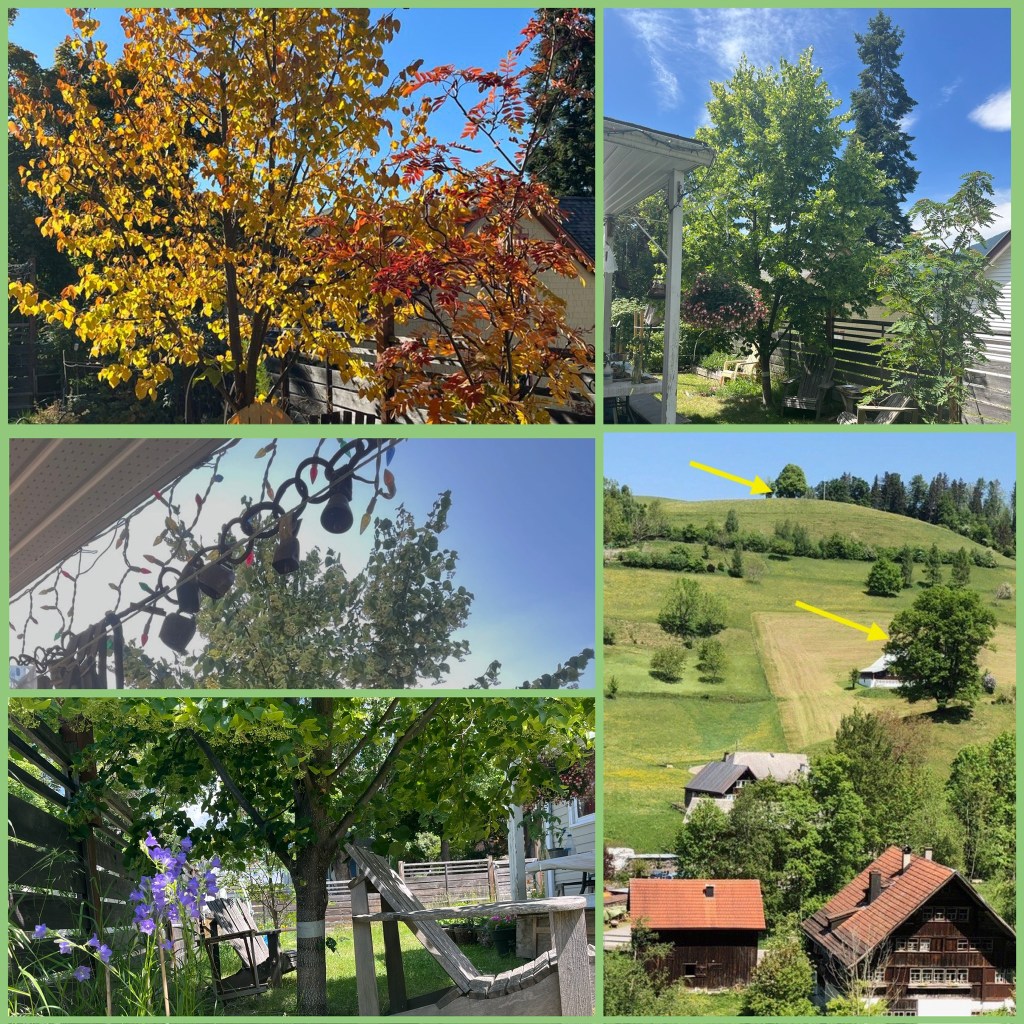
The lore of the Linden Tree
The linden trees grace many a town square and other significant places where people like to gather. Often there is a bench under the tree.
At the Musikakademie in Basel, where I studied, stood a great old Linden tree in the courtyard, which had a bench built around its trunk. This was for many the favourite spot to relax with friends between lessons or during intermission of concerts. In the countryside you find Linden trees on knolls and hilltops. Hearts with the initials of lovers are often carved into the bark. The leaves are heart shaped, slightly lopsided, as are their crowns.
In music, the 17th century Dutch song “Onder een linde groen” is well known through Sweelinck and van Eyck’s variations. The 12th century Minnesänger Walther von der Vogelweide wrote the first known (to me) song about lovers under the Linden. Unfortunately, the melody is lost.
Another famous song is from Schubert’s Winterreise, “Am Brunnen vor dem Tore”. The Linden tree is whispering to the wanderer that he could find peace by the tree, where he often spent happy as well as sad times, and carved so many loving words in its bark. This song also became a folk song and was part of the general singing repertoire in elementary school as well as a favourite in the many men’s choirs I conducted.
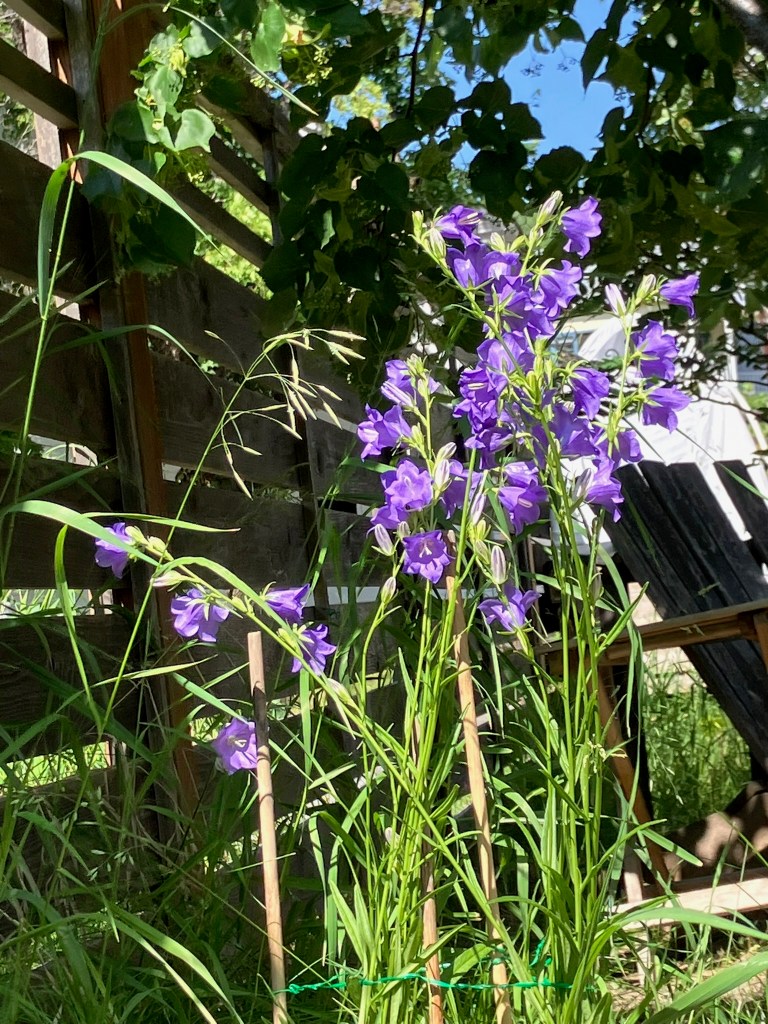
On a knoll by my first house in Trogen is a Linden tree and one on top of the highest hill. I too left those places with the Linden trees behind me, when I emigrated. Sometimes, especially when I play and sing the Linden music, I feel as if the trees are still whispering to me that I could find peace there. But now I have a Linden tree in my own little yard where I am very happy, especially now as my favourite flowers are blooming under the tree.
I share these Linden songs on my short YouTube playlist “Linden Lore”

YouTube @tobiasjenny1807 playlists, Linden Lore
2. Brahms and the Tendency to Depression
One day when I went to play music with my friend I sat on the bus with my instruments. A lady next to me was curious and wanted to know what instruments I play and what kind of music I make. My answer was classical. Then she asked me if it is true that to play classical music well, the musician should tend to depression?
This question took me by surprise. I was not going to disclose that a) I consider myself to be a good musician (not necessarily technically) and b) that for much of my life I suffered from severe depression. In this region of the planet called Canada there is a notion that classical music is to be serious. Whatever is not as easily followable like country and western or general pop music is not considered upbeat, even if it is in the major keys, because it is more complicated and not “spontaneous”. At church, even when I played some bouncy Mozart sonatas (and I played them well;), parishioners would ask me if I could not play something “upbeat”. Such comments kept me anywhere between flabbergasted and irritated.
Perhaps because of my tendency to depression I preferred music in the minor keys. It is dramatic. But one of my sisters commented that in our family music in minor seemed to be preferred. Was all of my family depressed, or did we just enjoy the higher levels of obvious complexity in music of the minor key? Since my elementary school days I was drawn to the romantic music, particularly Brahms and Rachmaninoff. Schubert was another favorite of mine. Brahms and Schubert I was able to play reasonably well to my satisfaction; Rachmaninoff however, not at all, to my chagrin.
About eight years ago, my depression got to its most severe level. I was playing Brahms’ op 117, known as the “lullabies to his sorrows” as he wrote to Clara Schumann. I consider op. 117, 1 very soothing as well as acknowledging the sorrows. Op 118, 2 I would put in the same category. Op 117, 2 and 3 are more turbulent, but in 3 there is a small glimmer of light in the middle. The most intensively dark however to me is op 118, 6. The opening is reminiscent of the “Dies Irae” sequence from the Gregorian mass of the dead (probably not by accident). I played all these and got pulled deeper and deeper into darkness. One afternoon, after working on them for about 4 hours I became dizzy and could not breathe anymore. Luckily I realized that as beautiful as this music is, I should not be playing it and I backed off.
Eventually I had to eliminate all music in the minor keys and concentrated on the “light” music by Bach, Mozart and Haydn. This opened up another (not unknown) world for me and kept me busy for several years. Eventually I was able to listen to the romantics again and after working my way through the “Winterreise” and the “Schöne Müllerin” (see my contribution on Schubert and the Lure of Suicide) I ventured back to Brahms again. However, I stay with the “safe” pieces. Also, because of Parkinson’s, I have to keep to the simpler ones since struggling with technical challenges is counterproductive to the flow of dopamine (see Parkinson Blog).
So, what would my answer be today to my fellow traveler on the bus? “Yes, maybe, but… “ After the Brahms abyss, I learned to be musically more playful. It was also helpful to have consciously retired from ambition. Now I enjoy the playfulness of the Goldberg Variations with all the riddles they harbor. It will be years of new discoveries every time I play them. But I am happy that I can safely play Brahms again for its beauty and complexity. While I love the simplicity of Alphorn music, I like the dialogues of the “inner life” in Brahms’ music. While considered homophonic, there is often as much polyphony hidden in his compositions as one can find in Bach’s music.
Can a playful person play Brahms or Rachmaninoff well? If Yuja Wang is as playful as she is officially portrayed, then the answer is yes. For happy folks with less abilities I can’t speak. However, really good musicians can play anything well, just like really good actors can play any type of personality. But where does really good really begin?
2 b) Brahms and Comfort
(2023-02-11)
After listening once again to Brahms’ Requiem, I was struck by how much comfort it contains. Brahms selected texts of comfort from scripture (quite a challenge) and his music reflects this. We know that he knew suffering too well. His musical comforting is (therefore) all the more consoling.
2 c) For an update see Parkinson’s #22
(2023-06-20)
3. Cafeteria Effect in Divisive Discussions
2021-12-02
(aka arguments) as demonstrated by the Covid crisis
Cafeteria Effect, my “definition”, or how I use this word in my deliberations.
A good cafeteria has a broad variety of food items with the purpose to feed patrons. Generally patrons have their favorites which they choose regularly. Occasionally they might venture out and try something new, which they then may or may not integrate in their regular selection.
It should be obvious that there are many different patrons with different preferences or needs to satisfy their needs or wishes. These needs may depend on the individual patron’s health and the wishes based on their cultural background. A good cafeteria meets many of these needs and wishes and is therefore catholic according to Chambers Dictionary of Etymology (1988, London. The H.W. Wilson Company) …..‘‘derived from Late Latin catholicus, relating to all, universal…‘‘
My idea to use the cafeteria term comes from my theology studies which I completed at a Catholic college. There the term ‘Cafeteria Catholic’ was often used as a derogatory term for Catholics who picked and choose only the bits and pieces of Catholic teaching they liked and ignored the rest. Ironically, as I observed, there is enough contradiction in Catholic teaching that consuming all that is offered in this Catholic cafeteria would result in severe digestive challenges. With other words, a Catholic needs to apply a cafeteria approach to meet their spiritual needs and wishes to stay healthy, both physically, mentally and spiritually.
I hope to have laid out well enough my approach in using the term Cafeteria. While as a Catholic it may be healthy to pick and choose what is agreeable for a healthy faith as it is in a real cafeteria setting. In science and politics however, a cafeteria approach can turn out rather toxic. The topic discussed below may serve as an example.
We are now approaching two years of Covid pandemic pandemonium. Fear is in my opinion the greatest contributor to this pandemonium. First it was the fear of the unknown that hit us with this new virus. This was followed by the fear of the powers that be (PTB) losing face in the public eye while they were stumbling in the dark. As the virus went literally viral, fear hit the general public. This fear was fed by the fact that the PTB began sending out contradicting messages to cover up for the embarrassment of not having the protecting equipment they were supposed to have in place for such an event.
Soon another source of fear emerged – the fear of state control. It became obvious that big pharma will emerge as a big winner and I think the enormous profits they’ve made by now support this suspicion. I am convinced that global corporations have considerable influence on politicians and public policy; however, I have no idea where and if at all we can draw a line between corporate and state control. It is therefore no surprise to me that a wide array of conspiracy theses, theories and ideologies have sprung up.
Personally, I observed the pandemic pandemonium panic with a sense of puzzlement. One placard a demonstrator carried at a rally summed it up for me: “Fear is the Virus” it read. The Covid virus however is also real and causes incredible suffering. For me, fear has no place in this situation, concern, yes. I am neither afraid of the virus nor of the vaccine. From what I gleaned in the wide spectrum of information and disinformation I figured that the vaccine is the smaller risk to take, so I chose for the first time in my life to voluntarily be vaccinated.
The majority of people I know take a pragmatic approach to handle this situation, some choose to be vaccinated, a few don’t. On both sides are people who are very well informed and look at both sides of the arguments. We make our decisions well aware that we cannot know all the answers, perhaps simply because we don’t have all the answers.
Some people however are panicking or getting paranoid from not having all the answers. They then may handle the situation by picking the arguments they feel the most familiar or comfortable with and stick their heads in the sand to avoid confusion. Others simply don’t bother to take the effort to inform themselves to the best of their ability. Not knowing often is a source of fear. To me it is rather comforting to know that we can’t know everything.
Fundamentalists and extremists (in a sense fundamentalists are extremists) are often picking their information from sources that themselves are already rather selective (biassed) cafeterias and lull themselves in the (false) certitude to be fully informed. On the other side are the conformists. Their cafeteria offers the mainstream diet, from which they pick whatever suits their personal comfort levels. I assume that both sides somehow must know or sense that their convictions rest on a shaky base. This may increase their fears. (see also quote at beginning of Musings #5)
Fear is often a fundamental source of aggression. When a person or a group of people have their convictions challenged they fear to lose their integrity or credibility and react with aggression. Two people that I thought I knew quite well reacted in an eerily identical way even though one lives in Canada and the other in Switzerland. Whenever I came up with an argument questioning the sources of their information they were not able to defend, they began shouting me down. When I did not give up my position they both changed the topic to trumpist election fraud and ended up supporting the Texas abortion laws while insisting that defending one‘s convictions and possessions with guns is perfectly ok. By that point they both were far enough down the rabbit hole to declare that using armed violence to stop TPB and defend “the constitution” is ok and necessary. Trumpism appears to be a fear based virus – immune to any vaccine – that knows no borders and is deaf to civilized reason.
This leaves me with the question: “is partial knowledge or information, cafeteria style, perhaps more dangerous than complete ignorance?”
4. Liturgy, its Value in Praxis and Life
About the Therapeutic Value of Liturgy, or how a simple daily routine can help us achieve higher goals.
2020-03-01, revised 2022-03-03
The term liturgy is generally used to forms of worshiping gods or a god . I therefore would like to clarify what I understand to be god, because I will hardly be able to avoid this word in my elaborations. To begin with, I want to emphasize that I don’t really care if god exists or not, because it really does not matter. What matters is how and what we talk and write about god. I consider god as a helpful concept.
Some conceive god as creator, all-mighty, all-knowing, kind, merciful, righteous, vengeful and most popularly loving. In my fifty years career as church musician and liturgist the one I heard most is that god is love. I cannot befriend myself with any of these descriptors, least of all that god is love. The only concept that some of my favorite mystics have come up with and that I can be comfortable with is that god is beauty.
From a mystical view, beauty is neutral; neither good nor bad, neither male nor female. Beauty cannot be defined. It can be experienced when it occurs, and those who have experienced beauty know it. It should therefore follow that the only pronoun to be used for god is it.
St. Augustin defined theology as the discipline striving to understand god, but warns that if anyone thinks to have reached an understanding, it won’t be god.
Where is this god? Nowhere and everywhere if at all. With our understanding of the cosmos, we certainly can’t explain heaven as a location anymore, so heaven too, becomes a concept as well. A concept dwelling in a concept is a bit of a challenge, but the simplest way is to go with the mystics again (including St. Paul) who say it lives within each individual, or even in everything, even the smallest grain of sand as Meister Eckhard beautifully describes. Eckhard writes about the spark within us (das Fünklein in uns). So if we worship god or pray to god, we address the beauty within us and come to realize that there is beauty in everyone and everything.
Swami Vivekananda once said ‘when people were in need or in trouble, god came to earth or sent a prophet who gave people religion. This would help the people, but alas, the devil followed on god’s heels and made a church of it. So why bother? Some claim that religion is the cause of all evil, esp. wars etc. Some believe that religion is the only way for people to behave ethically. Some truths may be found anywhere in between these extremes. In my experience, I could always find some traces of goodness among the congregations regardless how horrible the preaching of the clergy was. I could also sometimes find goodness in the clergy, regardless how horrible the congregation was. Essential for liturgy to be healing is beauty. Dostoyevsky said ‘beauty will save the world’. I agree.
So what makes liturgy therapeutic? Isn’t beauty to be found everywhere? The late Irish mystic John O’Donohue defined (original) sin as the loss of sense of beauty. If we look at our social and physical environment and are dismayed about the dissonances we observe, we probably can conclude that whatever bothers us is caused by someone’s loss of sense of beauty.
Ideally, liturgy is beauty or beautiful. I base my experience on the christian liturgies I was involved with through my professional work as organist and cantor. The cathedrals by themselves are beautiful, awe-inspiring, even if nothing is happening inside. Architecture is part of the liturgy. Some of the details may be ugly, like the gargoyles and the like. Gargoyles are part of life. Some of them look funny and make you laugh. Laughing is also part of life. As a whole many cathedrals and churches are simply beautiful.
Unfortunately, what happens inside is not always matching the environment. But ideally, the music and the spoken word are beautiful and inspiring as they should be. In churches that are based on a tradition of liturgy, we can experience the same cycle of rituals, prayers, music etc. every day or week. The liturgical year repeats itself every year, or since the 1960s every three years. The foundation of liturgy is in a sense based on repetition. Regardless of the complexity, regular church goers will find comfort and grounding in the familiar sequence of the day, week, season and year.
It is not necessary to like every part of a liturgy, as it is not necessary to like every word or sentence. Some might object to the Kyrie (lord have mercy) others might object to the Gloria. Many find it difficult to recite or sing the Creed, because it is so full of unbelievable stuff. The readings are often questionable to put it mildly. The sermons or homilies however, can make things better or worse, as the case may be.
The order of a mass as I experienced it in ideal circumstances is therapeutically balanced and could be used as a blueprint for many counseling sessions. It begins with the Kyrie, asking god and Christ for forgiveness. Since god is beauty and is the spark within us, we go inward, breathing in. The Gloria lets us breathe out, we rejoice in what is around us and divine (beautiful). In the Credo we take stock of what we do or don’t believe. We breathe out in the Sanctus again, singing along with the angels. In the Benedictus we begin going inwards to reach the before we acknowledge in the Agnus (breathing in) that which takes the sins away (re-establishing or re-enforcing our sense of beauty) and pray for peace. With communion we literally as well as symbolically take it all in, after which we give thanks (Eucharist) and go well grounded but inspired into the world (breathing out).
With the liturgical year we celebrate the life cycle of birth and death and all that is in between. Maybe we also contemplate what is between death and rebirth (i.e. between Good Friday and Christmas).
People are lucky if they can find comfort and consolation in this living, breathing, inspiring and grounding ritual. But what about those who have reason to feel utterly uncomfortable in a religious environment?
I go back to my friend Meister Eckhart. He understood quite well how people would feel unsafe around clergy and ecclesial rules. Confession is an integral part that prepares for the ritual of the liturgy. Confession in some sense is also crucial in the healing process of a therapy. It is difficult to heal when it is not clear what ails us. Meister Eckhart suggests that if you can’t trust your pastor, find another one. If that is not possible, go and confess to a friend, tree stump or a rock, because god (beauty) lives and dwells in all of creation.
So, for those among us who are not able to use religion to find our bearings (if we lost them) we have to create our own liturgy. I believe such a liturgy must be a similarly balanced and breathing ritual that is repeated over and over again, on a regular basis. During the time I worked as a baker, I followed the Rule of St. Benedict and sang the office of the hours. Benedict gave clear guidelines on which psalm or canticles should be sung at which hours on which days. It seems difficult to follow it to the dot in our days, especially in a secular setting. But Benedict had the wisdom to suggest that anyone who finds a better way to order the liturgy of the hours may do so.
I selected a set of psalms and canticles which I collected under the title Vespers of Wisdom and sang them every night as I was baking (see the YouTube link on the music page). I sang them in Latin and in English. I sang and contemplated. There could be weeks or months where singing the same stuff over and over again would be just “routine”. But now and then I suddenly had an “aha moment”; that is what this word or sentence (could) actually mean. Such insights would then carry me through the coming weeks or months.
I followed this liturgy for seven years and it enriched my life immensely. However, I developed an allergy to airborne flour and almost lost my voice. Fortunately I was able to sell the bakery and soon retired also from being a music teacher, performer and organist.
I took on a new instrument, the Euphonium (greek for beautiful sound). For the past seven years I began (and still do so today) every practice with a liturgy of warm-ups. As my abilities developed, so did my warm-ups. But they keep the length of about one hour, no matter what, which is a good length for any regular liturgy. I practice about 5 days per week, but often more. I practice regardless of how I feel. Keeping this liturgy of practicing and playing is grounding. I do it out of my own free will and for my own “salvation” of staying sane in this life.
Keeping up a religious liturgy likewise is good for this life, regardless of what official church doctrine tells us about life after death. Living in the moment, not for a potentially hypothetical situation after this life or just in the future is what is quite fashionable and sometimes even reasonable these days.
Let me make some suggestions that worked for me. After I got disillusioned with organized religion and much that comes with it, I made my own liturgies for my music practice. There is a personal history to it that demonstrates the value of regular routines.
After I got my teaching diploma for recorder, I did not practice or perform for more than a dozen years. However, I taught about 20 recorder lessons per week. I developed a warmup routine for my students that built up over the years spanning the basic technical requirements for the instrument. This meant that I played these warmups for years up to 20 times per week.
When I finally found good recorders which were inspiring to play, I picked up the pieces I struggled with for my diploma and played them better the first time than I played them at my exam.
The warmups were nowhere as difficult as those pieces, but obviously they kept me nimble and improved my technique.
When I started playing the Euphonium, I established a similar routine as soon as I was able to make a decent sound on it. Over the last seven years this routine has of course expanded and developed and I go through it each day. The short version takes about 25 min, the long version about twice as long. With the shorter warmup I can practice another 90-120 minutes, with the longer “liturgy” I can play until I fall asleep (two years later, and after my bout with Parkinson’s, I keep my warm ups to about ½ hour and play for about one hour). See also Parkinson’s Blog.
On the piano I did a similar liturgy, playing Schumann‘s Album für die Jugend every day before practicing if I actually did practice. Once I got a good handle on the Schumann, I was able to play pieces I struggled with before, regardless how hard I tried.
On the Harpsichord/Clavichord I did the same with Bach‘s Inventions and Sinfonias. Once I mastered them, I could tackle the Goldberg Variations and other toughies.
I believe that keeping a simple manageable routine or liturgy over years will help in staying grounded and focused. Doing a simple – ideally beautiful – routine enables one eventually to tackle more demanding activities, but I think it is good to keep the gears lubricated with the simple routine even when we can work well on the more demanding stuff.
5. Meditations, Affirmations, Prayers to Contemplate
In this section I would like to share some of the Prayers I found helpful at times.
I also use prayer as a collective term for meditation, affirmation and Mantras etc. Prayer is an often used word, often overused, misunderstood and sometimes abused as well.
Prayers are generally addressing god or some deity. About god, I have written in other musings and reflections. I always had, and still have some trepidation with this concept. I do get around these trepidations by “translating” god into what stands for the spark that lives in me and everyone and even everything (Meister Eckhard). In Prayer I (we) address that which we likely don’t know, regardless if it dwells within us or around us.
In contrast, affirmations address ourselves. They help us to reprogram (i.e. Neuro Linguistic Programming) the way we think or feel about ourselves. For people who are skeptical about addressing something beyond ourselves, affirmations may also help as a bridge towards prayer. Many self-help programs use affirmations quite successfully. They are in a positive sense something like brainwashing, a way to cleanse what we consider against our well-being.
Meditation is for me the most difficult thing to practice. I don’t think I ever managed it. To completely empty my mind and be in a state of non-thinking is daunting to me. Maybe I just have too high expectations of meditation (or of myself).
Contemplation is much easier for me. To take a mantra, affirmation, prayer or text and say or sing it to hear and listen to it over and over again can empty the mind of the stuff we don’t want to dwell over and replaces it with the words, sounds or meanings of the text or sound. We can also contemplate images or nature. In my experience of following the way of Benedictine spirituality I found that sometimes after months of reciting or singing the same psalms regularly, I had a big aha moment giving me insight of what the meaning of these often repeated words or phrases could be for me.
Biblical texts have been re-translated over the centuries every 50-80 years. Language changes and individual words can be turned into the opposite of what they ‘originally’ meant. I do the same. I translate words into what I believe is better for my understanding or the understanding of those I try to reach out to. I avoid any gender specific pronouns for god.I prefer to use It instead. This is anything but disrespectful as those familiar with C.G. Jung will agree. The Lord God I translate into creator, creator god or beautiful god, depending on the rhythmical verse requirements of the text. So far, beauty is the only attribute I can assign to god without choking on my words.
Contemplating beauty is central to many mystics throughout time. Augustine of Hippo contemplates this in one of his sermons on creation. Therefore I will begin my collection with this precious nugget.
Question the beauty of the earth
The beauty of the sea
The beauty of the wide air around you
The beauty of the sky
Question the order of the stars
The sun whose brightness lights the sky
The moon whose splendor softens the gloom of the night
Question the living creatures
That move in the waters
That roam upon the earth
That fly through the air
The spirit that lies hidden
The matter that is manifest
The visible things that are ruled
The invisible that rule them
Questions all these.
They will answer you:
“Here we are, look, we are beautiful.”
Their beauty is their confession.
Who made all these beautiful and changing things,
If not one who is beautiful and changes not?
St. Augustine of Hippo (335-430)
A bedtime prayer we prayed when we were little could be considered more as an affirmation.
I translated and adapted it from German.
From my head to my toes
I am the image of god.
From my heart to my hands
I feel the breath of god.
When I behold god
In all of creation
In mother and father
In brother and sister
In neighbour and stranger
In plant and creature
In earth and fire
In wind and water
Fear can not touch me, for I am never alone.
Affirmations can be found in many self help books, sometimes in fortune cookies and calendars. If an affirmation resonates, use it. Often affirmations also tell us what we need to know to let go of fear, as in the ‘prayer’ above. Sometimes they can be challenging to begin with, because we have to tell ourselves (affirm) that we are better than we think we are. We can also create our own affirmations to help us to overcome hindrances and fears. Good counsellors, therapists or spiritual guides can bless us with affirmations that can transform us to recognize our truths. Many alternative therapists and healing practitioners use the concept of chakras to focus their healing intentions in a ‘systematic’ way.
I ‘designed’ a set of seven affirmations based on the seven chakras as they are described in Eastern Body, Western Mind, Psychology and the Chakra System as a Path to Self by Anodea Judith, (Celestial Arts, Berkeley/Toronto 1996/2004). Judith assigns five attributes to each chakra.
- What is its basic issue?
- What is its element
- What is its typical demon?
- What is its basic right?
- What is its archetype?
The Chakras go from the root to the crown.
- I love my body and I take care of it. I trust its wisdom
- I listen to my feelings and I explore them. I experience the pleasure of living.
- I manifest my individuality without fear. I will myself to act.
- I love and I am loved. I perceive and I spread harmony.
- I hear truth and I speak truth. I express myself with clarity.
- I see what is around me and what is within me with the eyes of beauty. I manifest my vision.
- I know beauty and beauty knows me. To know this is healing.
The Kabbalah provided me with ideas for my meditation on the Tree of Life with the ten Sefira. The main source for this project were the two volumes Die Kabbala als Jüdisch Christlicher Einweihungsweg by Heinrich E. Benedikt (Verlag Hermann Bauer, Freiburg im Breisgau 1985/87). In contrast to the chakras, the Sefira begin at the crown (Emptiness) and end in the roots (Presence). This helps one to be grounded again after ending up in the ‘clouds’ with the upward chakra direction. The names of the Sefira (sing. Sefirot) vary depending on tradition and author. I will italicize the names in the meditation. In hindsight I consider this meditation to be more of a prayer. But there is a lot to contemplate here as well. The kabbalists did not make life easy, neither for themselves nor for those who try to follow this path of initiation. Based on the principle of the Emerald Table (Hermes Trismegistos) “What is above is below”, the crown actually roots in the above….
Beautiful God, grant me the blessing of emptiness that is pure and worthy to receive your gifts.
Let me fill this emptiness with the gift of wisdom that is clear and free from prejudice.
May this wisdom spread to the deepest reaches of my consciousness, that I may gain the gift of understanding of all things, complex and simple.
May this understanding help me to find compassion for all creatures, for rich and for poor, for friends and for enemies.
Let this compassion give me the strength to overcome hindrances, to face my fears and go beyond them.
Let this strength lead me to beauty that is the manifestation of the divine.
May I experience eternity being part of every moment.
May this experience guide me to behold the divine splendour that emanates from all creation.
May this octave of gifts and blessings become the foundation of all my actions.
So that my presence may be a blessing to all who are touched by it.
To round up this part of my reflection I will finish with the purpose statement of the church I worked at until my retirement. The congregation was struggling to find their identity in a way that would welcome new members. We discussed many variations of stating how welcoming we are, how open minded and inclusive we are but got usually mired in commonplace statements that were either saccharine or not completely true. Most members of the committee thought that as an Anglican congregation they have to mention God or Christ in their statement. I listened to what they really wanted to express. They also wanted a statement that was not like so many of the other parishes’ statements. I suggested that to be welcoming to agnostics as well, standard trigger words like God and Christ should be avoided, especially since each of us seemed to have a different image of god in their mind. So I came up with the following statement:
Our purpose is to seek truth, to nurture the sacred and to bless with love.
This resonated with everyone, and it still is the purpose statement of the parish. For an individual it could be used as an affirmation:
I seek truth, nurture the sacred and bless with love.
Or as a prayer:
May I seek truth, nurture the sacred and bless with love.
My favourite motto is:
Imagine Beauty
6.
deleted
^
7 Justice, Socialism and Forms of Communism.
I like to share some reflections on my practical and/or theoretical experience with forms of social justice and communism. There are historic, theological, and political aspects to these reflections with no claim to any scientific relevance. My reflections will also stay within the limits of my cultural background.
In early western history, social justice issues were addressed foremost in the scriptures of Judaism, Christianity and Islam. A tenor, which today is still relevant and also culturally acceptable in these scriptures, is the tenet to welcome strangers, feed the poor and heal the sick. Abrahamic prophets, including Jesus and Mohammed tried, mostly in vain, to put these tenets into practice.
However, even the priests would not put Judas’ blood money back into the temple coffers. Instead, they bought the Potter’s Field to bury strangers, paupers and criminals. The disciples muttered about the wasted money for the precious perfume used by the woman who poured it over Jesus’ head. It could have been given to the poor. So, taking the poor into account was clearly in the back of peoples’ minds in those days. Members of early christian communities were giving their wealth to the poor and lived a “communist” life. These early communist people lived their communism voluntarily. Monastic life was also modeled on giving up private ownership of anything and sharing resources equally among each other. Any Surplus was to be used for what would today be called social programs. On rare occasions, we can find religious communities that still live this way today.
Because the gospels preached consideration for the poor and outcasts, and valued men, women and slaves equally, christianity was initially mainly embraced by the marginalized. But it became more and more fashionable also among the wealthy, which resulted in whittling down the “communist” and egalitarian practices to their advantage. This already prompted the apostle Paul to rant in his letter to the Corinthian community. The misogynist remarks attributed to him appear to have been added later, as critical research shows (Bart Ehrman). Slaves were kept in slavery and women were “put back in their place” and religious hierarchies were soon established along the models Jesus was so critical of. The three virtues of poverty, chastity and obedience were conditional to the rules set up by the hierarchy. Poverty became relativized, chastity became exaggerated into the travesty of obligatory celibacy and obedience became relative to the position in the hierarchy. Hierarchy unfortunately means power, and power corrupts.
Christianity gradually slipped back into the “dark ages” of power and exploitation which the prophet Jesus tried to light up. Christians who argued to revert to the original values of their early predecessors were often persecuted. Some started their own independent communities that sometimes lasted for a while.
The way towards attaining a better level of social justice was finally paved during the French revolution’s attempts to abolish social hierarchy and create more equal rights for “everyone”.
While this changed the lives of many for the better (with considerable hiccups), exploitation raged in factories. Marx and Engels thought to have some answers with their idea of communism. When I red the Communist Manifesto I felt they were dead on but I was also alerted to the fact that Engels cautioned that the wealthy class would resist, and this system could not be enforced without bloodshed. The Russian revolution has confirmed this. While the Russian revolution was “successful” in the sense that Russia became a communist state, communism obviously failed. I believe that the reason is similar to the failure of christianity to become what I think it was meant to become. Right from the onset, as in early christianity, a hierarchy was established that created corrupting power structures.
It appears that Pope Leo XIII must have recognized this when he wrote his encyclical “Rerum Novarum” (1891). He was as critical of free ranging capitalism as he was of materialist communism and socialism. His encyclical suggested a solution that would benefit both, the workers and (in the long run) the employers. Work conditions had to ensure the workers’ dignity and health, and the wages had to be high enough to support, feed and house a family (including the spouse, in those days of course the wife). People were to be able to have free days to relax and/or to celebrate and practice their beliefs. This sounds reasonable, but fell mainly on deaf ears. However, it gave considerable upwind to the union movement.
The union movement clearly was a severe threat to the exploiting elites. For quite a while, particularly in North America, the unions were considered communist, and, because they were strongest with moral support of the catholic church, catholics were shunned and marginalized until well through the first half of the 20th century. Eventually, unions became strong enough to create some positive results for the workers but unfortunately soon the power of the union bosses corrupted them and all too often the workers were caught between the power struggles of the unions and the employers. So once again, a corrupted hierarchical system destroyed much of what the grassroots were set out to build.
Proponents for catholic teachings of social justice also faced severe head winds, because the corrupt majority of leaders of catholic institutions were working hand-in-glove with the wealthy elites. However, a small minority of clergy serve as worker priests and lay people (and some of them get murdered, like bishop Romero), and keep up the work that pope Leo XIII started. This work can function because it is not directly “run” by the hierarchy and is therefore hardly corrupted.
As the capitalist system at the beginning of the 20th century was challenged by the communist movement, Rudolf Steiner, founder of the Anthroposophical movement, came up with the concept of a “Threefold Social Order”. Before he became famous for his mysticism and “spiritual science” he called Anthroposophy, he was well known as an economic or business consultant (as we would call it today). Many organizations like schools, hospitals, farms and factories that use his ideas continue to be economically and socially successful. Those organizations that don’t fully apply the guidelines, usually appear to be temporarily just functioning between crises. The reason why the system works is because of the strict separation of the three main domains of social activity which are: economic, legal (or professional) and cultural (or spiritual). Each of these domains functions independently from the other two. It requires a substantial amount of trust between the people working in the individual domains.
As an example I will describe the functioning of a school. The workers are equally valued, regardless of their work. They are paid according to their needs. The amount each individual is paid remains confidential between the finance manager and the employee. This results in a much smaller wage gap between teachers and support staff. In the weekly conferences (staff meetings), they all meet together to discuss issues of the day, but also general cultural issues that affect the operation including teaching. If a parent is in a situation (as I was once), where only overpriced housing is available, the school fees are either waived or reduced to what can be afforded. If a teacher’s income from other sources is high enough to get by (as I once was) he works voluntarily for free. The wage gap between essential custodians and senior teachers is negligible. The cultural running of the school, events, professional development etc is also independent. Of course, everyone is informed how much money is available and makes their demands accordingly.
When custodians can share their experience of a problem student in the faculty meeting, their contributions are valued as much as when teachers clean up after themselves. When every full time employee makes a living wage or better, there is little discontent and any problems that arise can be addressed in the weekly meetings, or confidentially between the people involved. It takes a lot of trust, and sometimes this trust gets broken, which can result in a temporary (or at worst ongoing) crisis. It happens. I have experienced it. But grudges aside, I consider this model the best functioning social justice model that I know.
A similar, but more communist model that has functioned since the 6th century is the Benedictine monastic model. While there were throughout the history of this movement huge waves from absolute austerity to obscene excess, the model and movement still functions and many monasteries continue to prosper. The Rule of St. Benedict (apart from some cultural developments that happened since it was written) is still applicable today. The secret again is for one, a well thought through model and independence of each individual monastery.
Unlike other catholic orders, there is no “general” in Rome to micro-manage individual monasteries. There is an Abbot Primate for all the Benedictine monasteries on earth, who is elected for a single eight year term, but has no power to make decisions for any monastery. His function is pastoral and to advise. There is a clear hierarchy within each monastery, and things often don’t work out as well as they should, but the hierarchy lies more in who has which responsibility than who has more power. However, if necessary, the buck stops with the abbot. The abbot is elected by the community without influence of any other monastery or institution, and only has to be approved by the local bishop. When a monastery gets too big, some monks are sent out to begin a new monastery, which becomes independent as soon as it can function on its own.
Big corporations that face collapse under their own weight should take note, and some actually do. Some Benedictine monks now work as consultants for corporate restructuring. In a similar way, Rudolf Steiner did the same in his days. One “side effect” of this was the foundation of the Waldorf schools. The Benedictine Rule of Leadership by Galbraith and Galbraith, Adams Media, Avon, MA, 2004, makes for a fascinating read.
I would like to consider myself a socialist or even communist. However, there are serious barriers to giving myself such a label. The main barrier is that “everyone is equal” according to some socialist ideologists. The world then would be as boring as the culture was under Soviet rule. The gray in gray, the lack of beauty in Soviet cities makes this visible. Equal rights, YES, but diversity in gifts, talents, traditions, languages, cultures and even religions is what makes life human (as long as there is acceptance between diverse groups). Elitism on the other hand is just as toxic, even though some people might find it entertaining. When richer and smarter equals better, then we are on the wrong track. When elitism and entitlement is causing power imbalance, social justice suffers. When spiritual elitism finds its way into spiritual thinking or teachings we soon find that toxic corruption, as we see it in institutionalized religion, is destroying the very idea that the initiators of these movements envisioned.
As appears evident from my reflections, for societies to function in a humane and socially just fashion, organizations have to stay small enough to allow for clarity who is responsible for what. Competencies between domains should not be mixed up in conflicts of interest (or wish for power). Both Benedict and Steiner mentioned that if people find better ways to execute or practice their teachings, they should do so. This however, requires a good understanding of their teachings. Times change, and so should therefore the application of any teaching or tradition adjust. Vatican II called this “aggiornamento”.
Unfortunately, in both the application of the Rule of Benedict (and catholic teaching in general, which in its structure is much less flexible) and the application of Steiner’s teachings many followers insist on sticking “to the letter”. With their fundamentalist or orthodox zeal they undermine much of the essence of that which made their movement successful in the first place. At worst, they turn it into a cult. Usually, social justice becomes the first victim of such dysfunctional behavior.
Fazit: It seems that solutions to make society just have been available for thousands of years, but we humans just don’t want to admit that we “get it”. So we can comfortably pass the buck to the sometimes unknown and usually corrupted power.
8 Sentences and Shame
Mid November 2022
On my last visit with Wim Borsboom about 15 years ago, we talked about many things. One thing that really stuck with me, and still remains in the back of my mind is the concept of sentences. Having read Arno Grün’s book The Insanity of Normality (or in German Der Wahnsinn der Normalität), provided the background for me to sense that I really understood how these sentences can influence our whole life. For me, one sentence in particular made my life more difficult than necessary. By the time I was 10 years old, I had developed the typical symptoms of dyslexia and ADHD, and was sent to the school psychiatrist. His verdict was: “Tobias is gifted, but lazy”. This sentence influenced my life all the way from 1961 to 2006. On one hand, I felt pride for being gifted, a sentence I also regularly heard from my parents, but on the other hand it burdened me with a deep feeling of shame.
On top of this, knowing the parable of the three servants in Matthew 25:14-30 was not helpful either, particularly because it is so close to life as we experience it. Some people are more gifted than others and in a culture influenced as heavily by christianity as the Swiss, where hard work is the highest virtue, long before faith, hope and love, the sentence the third servant got was “you wicked and lazy servant…. And throw that servant outside, into the darkness, where there will be weeping and gnashing of teeth”. I grew up surrounded by precious art books with colored prints of the great medieval and renaissance masters. So I had a pretty good picture of what this darkness would be like that awaited me.
It never occurred to me how idiotic, cruel and unfair this master really was. Because we of course were taught that the master in this parable describes god, and god is supposed to be good, loving and merciful. It never occurred to me that it could be possible that Jesus said really stupid things that were dead against anything that could be considered “good news” (Evangelium). Giving Jesus the benefit of the doubt, we could argue that Jesus never said anything like this. One bible critic once hypothesized that all the good things in the gospels were actually said by Paul, not Jesus. In hindsight I tend to agree. How do people with mental or physical challenges (in biblical terms the less gifted) feel about this damned parable?
The sentence of being gifted but lazy hit all the more home, because I felt that I was given five talents, not just one like the third servant. It also never occurred to me, that this school psychologist was quite stupid as well. Decades later, I told this story to Martin whom I met for the first time at a party (still thinking there was nothing particularly wrong with it, because dyslexia and ADHD were not commonly known in the sixties by older psychologists). Martin responded, “that psychologist must have been my father, he said this about many of his clients”. And when describing where the office was, Martin confirmed this was his dad.
The power of my sentence is all the more mind-boggling because I was anything but lazy. In my early teens I loved working on the neighboring farm and spent as much time there as I could. Often I got up at 4 AM to cut grass, feed the cows and milk them before getting on the 7:09 AM train to go to school. I practiced multiple instruments (see in the page “about some of myself”), spent the summers working on the alps working up to 20 hour days. Later I often worked 6 ½ days per week, ran a farm or bakery etc. But I still believed that I was lazy.
A few days ago, I was pondering to finally write about the concept of sentences and shame and jotted down a few thoughts:
Life with shame
~~~~~~~~~~~~
Shame isolates.
Is the shame justified?
If so, how get rid of it?
If not, how get rid of it without creating more shame or embarrassment?
~~~~~~~~~~~~
Does it come from being sentenced?
How much comes from self-sentencing?
How can these sentences be undone?
~~~~~~~~~~
Shame towards whom?
About what?
Why?
Yesterday, my wife Joan sent me the following link asking:
“Wondering what you think of this:”
The article muses why (Australian) men don’t have as many “mates” with whom they share their feelings as women do. So today I answered (in my answer I do not say how men and women are, but how I perceive broader society in our culture has been conditioned to think about them):
I answered:
well, it is kind of a standard narrative. how people deal with it depends a lot on the sentences they received and how much shame is attached to these sentences. for women, the shame is more upfront. they are guilty of original sin. they have to cover their hair. when they are raped, they “were asking for it”. so shame for women is more normal, because it is almost a virtue for a woman to be ashamed, and so they can talk about it more easily among themselves.
for men shame is too shameful to even mention it, because they have to be strong etc. besides, they have been indoctrinated that whenever they get aroused by a woman, that this means they are real men, and if they can’t contain themselves, it is the women’s fault. so they don’t even know what bothers them, or that they are actually bothered at all. so how can they talk about it?
if it were the other way round, men would be wearing blinkers (Scheuklappen), because it would be their shameful shortcoming for getting excited about seeing the “potential” of women’s charms. if islam style religions would have been designed and run by women, men would not be allowed on the streets without their wives or sisters chaperoning them.
I think this pattern applies to most other feelings as well.
She replied:
Makes sense……sadly, perhaps.
After this, I finally wrote down these reflections.
PS. November 29, 2022
Germany, as a nation, remembers the Holocaust with open shame. They cultivate the memory in order to avoid history to repeat itself.
Russia, as a nation, did not allow its citizens to remember the Holodomor and all the millions killed by Stalin’s crimes against humanity. Recently, the organizations that worked toward remembering Soviet crimes have been shut down again. Clamping down on any opposition appears to be a conscious build up to the situation we are in since February 24, 2022.
When I was in Russia, I never heard a single person ever blaming the Tsar, Lenin, Stalin etc. for the misery they inflicted onto their people. Also Putin was never blamed for anything that went wrong under his rule. Instead, they just blamed the apparatchiks. When I lived in Germany, I never heard anyone not blaming Hitler for his crimes.
In these days Russia once again uses hunger and cold to get people it considers “its own” (but inferior) on their knees. Could this have happened if Russians would have held their leaders responsible?
9. About Interpretation, a Rant
2023-01-02/ About Interpretation, A Rant
Pre-PS, my son tells me that this rant is an interpretation of the situation 🙂
I am in the process of reading Christopher Butler’s Postmodernism, A Brief Insight (Sterling, 2002), as well as studying the sermons by Meister Eckhart. What a contrast in content! A passage on Metaphor in Butler’s book led to this rant which I am posting on my music, theology and personal reflections page. In this passage, Butler instructively deconstructs a (rather insipid) poem by the young Tennison to demonstrate deconstruction.
This threw me back to a high school German class where we had to “interpret” a poem. I had just switched from the Waldorf School to public high school. The teacher presented a poem, similarly sentimental as Tennison’s and wanted us to tell what we thought the poet was thinking. Coming from the Waldorf system, where everything had (to have) a deeper meaning, as well as being steeped in theology and world religions at home, I was trying to find some deeper meaning, when the teacher asked me to elaborate. Since I could not give a quick answer, because I saw no more meaning than the words themselves expressed, I didn’t know what to say, because I believed that since I was asked, there should be some deeper thoughts behind the poem.
So my neighbour at the next desk was asked instead. He just turned the poetry into prose, using basically the same words, and got high praise from the teacher for this “interpretation”. I was dumbfounded. This episode was the pint that made my bucket overflow. I decided to drop out of school, because I did not want to waste my time with such idiocy. If this teacher would have been better informed by postmodernist deconstruction, he would not have asked such a useless question. It did not occur to me that at that time in public schools much of the time one was simply expected to correctly regurgitate what was taught to pass the grade, because in the Waldorf school, I was under the (legitimate) impression that the teachers were actually teaching to enrich our lives, rather than just administering a curriculum. (I also rant about this in my reflection “What Method Do You Teach?” on the music page.)
Many poetry readings I attended, had some poets read their platitudes by attempting to suggest some profundity to their opus by chopping sentences of prose into arbitrary line-breaks which were accentuated with much gravitas and solemnity and sometimes also adding “the most expensive words” they could conjure up. I observed that some of these stylistic habits also made their way into church, where lay readers read the scripture very theatrically. This is obviously not a new trend, considering that there must have been a reason why until Vatican II priests had to chant the readings in a monotone way to ensure that only the words would be heard and not the personality or interpretation of the reader. The words of the Bible were considered meaningful enough that they did not need to be distorted by interpretation.
I have a similar beef with music. Good music, played well, does not need any interpretation, as some mediocre music teachers seem to believe. A good musician can play with the music, even let it be different at each performance. Good compositions can handle that. What they can’t always handle is arbitrary interpretation. Glen Gould, at least, had a reason for his provocative, arbitrary (and genial) renditions of Bach (among others). He was tired of the all too standardized renditions of his time and wanted to demonstrate a different way of playing music. Unfortunately many musicians jumped on his band wagon and aped his way of playing, creating a new standard, tainted with over-interpretation. I believe that every musician who can play with the music, will sound alive, without “having to interpret”.
(Prepare for a bit of a jump from rant to ramble….;)
Likewise, the content of Dante’s or Shakespeare’s works are interesting enough that they make a great story, even if one does not know the historical context. Of course knowing the history of their time will make their masterpieces even more interesting. Their genius of writing in flowing verse and rhythm adds to their beauty. They were literally playing with words. Reading Dante’s Comedy needs a skilled reader, but I doubt it needs an “interpreter”. However, Shakespeare’s plays may need good actors. I believe that good actors can assume the character they are playing without being recognized as who they are in daily life. I think personal interpretation is somewhat secondary to good acting.
Unfortunately, many theologians have interpreted the Bible (which is not always a good story), and later theologians have interpreted their predecessors. This kind of “telephone game” led to distortions that caused wars and horrendous suffering. All in the name of a god whose character was based on mere interpretation or assumption. “Thou shalt not make a graven image of God” is in my view the most important commandment. Unfortunately it is also the most ignored. The bible is full of “graven images” through its descriptions of a god who is depicted with many horrible, and a few good characteristics of humans. As Voltaire said: “God made man in his image, and ever since man has attempted to return the compliment.”
Meister Eckhart has much to say about the image we engrave in our minds of god. He also gives very compelling arguments in his sermons that can help us to follow the commandment of not giving attributes to god. St. Augustine figured it out as well, when defining theology: “Theology is the discipline to help us to know God. However, when we know God, it isn’t God.” Therefore we should question the value (or meta narrative) of interpretation. Considering that through the ages, music was (and still is) considered the language of the angels, we should question interpretation – for the sake of interpretation – of music as well.
What about bad music?— Ever heard of fallen angels? We shouldn’t judge, but we may (or must) feel. Those who have reached a reasonable level of individuation will feel differently from any other individual. As long as we can trust our feelings, we won’t need to judge.
10 Communication
2023-02-03
Communication appears to be a basic need, not only for humans, but also for many animals and apparently even plants. Humans have means to define needs. They find ways to ensure such needs are met. Unfortunately, humans also have the special ability to ignore other people’s needs and put their own needs above all others. In severe cases, humans find a name for this special ability: Narcissism. Narcissism is considered a disorder when certain criteria are met. There are of course many other disorders that can contribute to the spectrum of behaviors which manifest in humans. Looking at humanity I wonder if simply being human should be considered a disorder.
Communication as such is neutral. The word does not imply any characteristics to be prevalent. Communication can – and sometimes has to – be friendly, aggressive, gentle, harsh, etc. We don’t know much about communication between plants, so I leave them out of my considerations. In general, communication between animals is as clear as possible considering the available means to each species. In my observation, animals generally do not ignore any communication from other animals that is directed towards them, whereas humans more often than not do ignore such direct communication. I guess, this is one of those things that makes us human, and I feel this is one of the reasons why on occasion I consider being human as a disorder in itself.
Some ways in which I found communication more accessible are through music and farming and I attempt to explain why.
If I want to communicate something to someone I also expect a response, I am responsible for using a way of communication that is understandable. Using the right language is helpful. However, I am not solely responsible for the success of my communication. The recipient(s) of my communication will need to contribute some of their own efforts to make the communication a two way event. Even telling me to shut up would be a better response than silence. Simply acknowledging having noted my attempt to communicate is better than leaving me in the dark if my communication actually has reached them.
While I play a lot with words, I had no intention to turn my ramble into the subtitle of responsibility to respond. But there is a connection between the two words, and this connection by itself is potentially communicating something as well. I do my best to respond to anyone’s attempt to reach out to me (unless it is just spam). I am aware that I am not particularly interested in certain topics like sports. But if someone reaches out to me, I am at least interested in what makes them interested in sports and communicating my curiosity might actually lead me to become interested in at least some aspects of sports. It has happened.
One of my worst beefs is that so many people simply lack even the most basic amount of curiosity in finding out about new things. Curiosity is quite likely the most important ingredient of intelligence. I feel sorry for people who are too dumb (or numb) to be curious, and I have little respect for those who are just too lazy to check what life has to offer beyond their narrowly staked fence (about fences, see top of this page). And some people do not only fence themselves in but build unmovable brick walls around themselves. It is very sad when people are born into a tightly fenced or walled environment. Their experiences are often based on generations of set prejudice. Prejudice is after lack of curiosity the next serious communication killer, even if the prejudice is positive. I will illustrate this with an experience I had while performing.
I have quite a broad experience in performing all kinds of music for all kinds of audiences. Of course the audiences also experienced various levels of quality of my performances. My first years in Canada were challenging. One job was as organist/choirmaster at a very conservative Presbyterian church. I came in as a long haired bearded hippie from a church music tradition that was quite opposite of what that congregation was used to. As young as I was then, I was also too inflexible to adjust to the musical language they were used to. On the other hand, I only used music that I liked and could fully stand behind. The initial resistance was formidable, but the majority of the choir and congregation soon began to appreciate my work and the new music they got to experience, and within about six months I had many fans. Until that point I felt I was jack-hammering my way through a concrete wall, but when I broke through I was successful. This was a great experience.
The other job I had was running the music program at the local Waldorf School. There it was the opposite. With my background in Anthroposophy and anthroposophical music therapy I was received like an “initiate” to their “mysteries”. Setting up a music program for the school and teaching long hours left little time to practice my instruments, yet I played all sorts of concerts at the many events that happen in a Waldorf School. There was absolutely no resistance to my music, regardless how bad my performances were due to lack of preparation time. All my performances were well received and lauded, just because they were positively prejudiced towards me. This was extremely stifling. I felt I was trying to break through a foam mattress with a sledge hammer. There was actually no real feedback and therefore no real communication. After three years of sledgehammering the mattress, we decided to move back to Switzerland for some time. I was so burned out that I could hardly play any music at all for more than a year.
At some point I got back into playing and found a great partner in Ernst Meyer who was an excellent recorder player and later became known as the “Stradivarius of Recorder building”. We played several concerts together. Communication was near perfect and purely musical. We never had to discuss how to interpret a piece. We never played a piece of music twice the same way. We did not need to count in, or even see each other to play together. Sometimes I was up in the organ loft and he was down in the choir. We skipped or added repeats without signaling. We were completely in sync. This was the highest level of communication I ever experienced. I was lucky to now and then perform with other musicians that were also in sync with me (or I with them). Today we can experience this when watching/hearing musicians like Janine Jansen (my favorite) with a chamber ensemble or symphony orchestra, and Kathia Buniatishvili. Of course, when I play music by myself, the instruments respond honestly. Maybe this is why I like playing so much.
Now I turn to communication with animals. I always loved working on farms and as a shepherd in the alps. My all time favorites were the more independent animals like goats and cats. I think that has also to do with their curiosity. Compared to the cows, sheep and dogs, they respond less predictably and more independently. Communication was more dynamic. Horses and donkeys are abit more of a challenge, perhaps like polyphony. But with all the animals it was always “on equal footing”. I was never ghosted, and I never ghosted them. Farm animals also have a tendency to know their place in the hierarchy and accept me, even if it was only because I was their source of food and shelter security. The animals are rarely subject to mood swings (except for horses and donkeys) and make wonderfully stable companions. Having to butcher them was the main reason why I stopped farming. I never got used to it. On the contrary, it has become a worse nightmare year after year. So now I am stuck with just humans again.
P.S. Since November 6,.2023 I learn to communicate with my invisible friend (see Neurotheology in Parkinson and Theology Pages). This is quite amusing, entertaining and awarding.
 Reflections