
Page Overview (Low tech scroll down;
- “The Alphorn and It” an essay about the archetypal power of playing the alphorn (or alpen horn) and hearing its sound. An essay (With a little Video)
- The Fixed Vowel Resonance Pitch and how it led to the standardized tuning of of the alphorn. A hypothesis (updated 2023-08-20)
- “Pfiffiges auf allerlei Pfeiffen”, a program for organ, recorders, hammered dulcimer and harpsichord, played by Monika Musch and Tobias Jenny, May 9, 1993 with soundtrack.
- “Alphorn Essence”, a recording of alphorn hammered dulcimer music, played by Tobias Jenny with soundtrack. This is also available on my YouTube channel.
- “Alphorn-Russia”, a video of my concert tour in Russia in 2010 with soundtrack.
- My CD “Chains” uploaded to YouTube. Click on the orange Circle with “T” look for playlists and select “CD Chains” for all the tracks as playlist with soundtrack and slide show of a hike to the alps where I worked as a teen.
- Recording of “Wisdom Vespers” Gregorian Chant accompanied with Tibetan singing bowls, with music and texts. Click on the orange Circle with “T” look for playlists and select “wisdom vespers” for all the tracks as playlist with soundtrack and score.
- The natural Harmonic “Scale” and Concert Pitch
- What Method Do You Teach, or Cultural Assumptions in Music Teaching
- Vowel Resonances (Updated 2023-08-20)
- About Interpretation, a Rant (2023-01-06)
1. The Alphorn and “It”
This essay was first published in 1999 on my original web-site and in some newsletters of Swiss societies in British Columbia. The Jungian approach to “It” is based on the writing of Theodor Abt in“Fortschritt ohne Seelenverlust” (Hallwag, Bern, 1983).

In some Swiss valleys, exposed to the raw forces of nature, which were until recently isolated from most outside influences, a primeval view of life was kept by their inhabitants. To them, the surrounding of their homes was animated. The mountain people called this ”It”. ”It” calls, ”It” asks, ”It” throws rocks, ”It” makes the weather, ”It” takes the cattle and brings them back. ”It” brings good or bad luck.

This ”It” is not a way of thinking, it is a form of experience, “It” has its own life and power. It explains the state of affairs, including the inexplicable. It has no personality, neither divine nor demonic, neither good nor bad. The ”It” is experienced as a living force in matter, and it is imperative to deal with it with the right insight. It is considered blasphemous, not to respect manifestations of the ”It”. ”It” has an irrevocable influence on life in (with) the mountains. In spite of Christianity, which took hold in the Alpine region since over a thousand years, people kept communicating with ” It”. They were part of ”It”, When they had to move away from ”It”, they often perished with homesickness.

A way to communicate with ”It” was, and still is, music. Incantations either sung, or played on the Alphorn are still used for this purpose. The mountains (or ”It”) answer back with their echo. Listening to some of the ancient Alphorn melodies may also give us a glimpse into what a player wanted to tell ”It”. One can hear despair, challenge and surrender in those melodies, and one can hear happiness, calmness and serenity as well, since the people were generally content with their rootedness in the mountains, and did not easily get tempted to move away.
*

When Swiss mercenaries started singing their songs of the mountains, they got so homesick, that they deserted, which of course threatened the instability (!) of Europe (or the stability of war). Since the 17th century, scientists studied this phenomenon, called it the “Swiss disease”, and could only find one cure for it: the return to the homeland, or to ”It”.

The Alphorn is, in western culture, the only commonly played instrument today, which does not use the Well Tempered Tuning, or any earlier tuning systems which led to the sound we are now so completely used to. The music played on the Alphorn is made up of the natural tones of the harmonic scale. Often listeners may have a sense of “wrong, or out of tune” notes, when they hear an Alphorn play. These are foremost the 7th, 11th and 13th notes of the harmonic scale, which are very different from any notes in our present tone system (see post #8 on this page). Until the end of the 19th century, there could be still some people found in remote areas of Switzerland, who were neither exposed to the Well Tempered Tuning nor to Alphorn music. They have been reported to have sung with the natural notes of the harmonic scale. One may conclude from this, that the natural way of singing was in fact using the natural notes of the harmonic scale (which we would consider out of tune today).

To this day, Alphorn melodies as well as “Zäuerli” (a predecessor of the yodel, using the natural tones of the harmonic scale which are still being sung in the Alpstein mountains of Switzerland and played on the Hammered Dulcimers in that region) draw tears from expatriate Swiss. The effect seems also to be on some non-Swiss people. I guess it has to do with our archetypical collective subconsciousness, the consciousness, where the natural tones of the harmonic scale are still alive. It creates a resonance which gives us a notion of our connectedness with ”It”.

Science and enlightenment helped us understand and find reasons for rain, snow slides and thunder, in exchange for this enlightenment, we lost the need and ability to communicate with ”It”. Today, as physicists delve into particles and waves and ever smaller things, they are getting more and more a sense of ”It” . The realization prevails, that there is more than just matter, and scientists often find themselves compelled to ponder about the spirit behind it, or, as it may be, ”It”.

In many people today, there seems to be a wish, to be more connected to the spirit of nature. The Alphorn is an instrument, which, through its tradition of communicating with ”It”, may create a link, which may to some extent enable us to find our own ways to reconnect with ”It”.
The tradition of using the Alphorn also to calm the herd (as well as the herder), may build a bridge to reach inner calmness, which we so desperately need in this hectic time. The Alphorn can help to remind us one way or another, that there is ”It”.

2. Some thoughts on the standardized tuning of the Alphorn
The question often comes up why the common standard tuning of the Alphorn is in f-sharp/g-flat. This certainly makes life difficult for those who would like to combine the Alphorn with folk instruments that cannot play in this key. I believe that I found a possible answer to this question. I came to it via some detours, which I would like to describe as well.
My extensive involvement in Gregorian chant led me to this same note F# for the recitation tone. Many monasteries have settled on this pitch, despite the challenge it poses for possible accompaniments. The monks simply went flat, when they tried to sing in the more practical g-pitch. We know that in many places the “concert” pitch was a semitone lower than we have it today, and this could be one explanation, but why could the monks not stay in tune with today’s G? I think I found the answer in the acoustics of “fixed vowel resonance pitch” and in my extensive singing and voicing experiments.
Each vowel has a particular resonating pitch. This pitch is the same every time the same vowel is sung by anyone, as long as the shading (or accent) of the vowel is the same. It is what we hear in so-called overtone singing. Overtones are the harmonics based on a root tone or tonic and follow the harmonic scale, which we play on the Alphorn. The “overtones” of vowels however; do not change, no matter what notes or pitches we are singing, hence the term “fixed vowel resonance pitch” (Scientifically, “overtone singing” is an incorrect term). The resonance tones of the clear vowels in the Latin A-E-I-O-U are all in harmony with F#, which means that when we sing in G, we are fighting against constant dissonances (even though we may not be aware of this). This is one of the reasons why a good choir leader insists that everyone sing with exactly the same “accent”. The clarity of sound improves considerably when not only the basic pitch is in tune, but also the vowel resonance.
Yodeling and the singing of “Zäuerli”use the same clear vowels as Latin chant. The Alphorn became popular during the revival of the Swiss folklore movement and was sponsored by many a Yodel festival. It seems that without accompaniment, Yodeling gravitated toward the F# pitch (which in older tunings was closer to the G pitch) to create the purest sound, and the Alphorn makers matched their instruments to be in harmony with the singers. Considerable historic research would be needed to back up my hypothesis. Perhaps, someone will take this challenge.
I have another theory why my hypothesis could be accurate. In many regions of Canton Bern, we find Alphorns tuned in F. The vowels of the Bernese dialect are in a noticeably “darker” shade than the rest of most of Switzerland. These darker shaded vowels produce lower resonance tones, which means that the Bernese dialect resonates better on F than F#. I therefore believe that connecting “fixed vowel resonance pitch” with the standardized tuning to F# of the Alphorns should not be mere coincidence.
See link to youtube video on related topic on the Links for discussion page

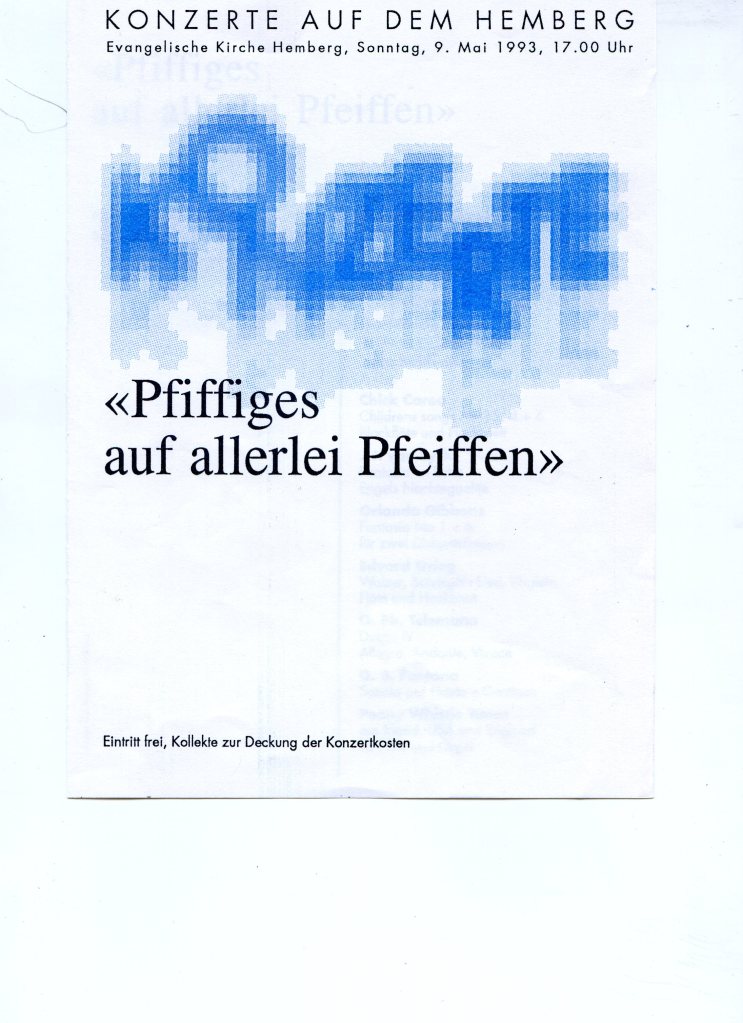
3. Pfiffiges auf Allerlei Pfeiffen
This is one of my Favorite programs from before I definitely moved to Canada.

4. Alphorn Essence, a Recording
Below Is a copy of a recording I made for a Cassette Tape back in 1998 with music for Alphorn accompanied by Goat and Cow Bells, interspersed with alpine music I play on the Hammered Dulcimer. It is a very low tech recording using simple recording tricks like hanging the microphone behind the piano which has the pedal blocked to create some reverb. The bells I had on a rack playing them while playing the Alphorn. It seemed easier than figuring out how to sync two recordings together.
In 2010 I was invited by my former Orchestra in Zürich to join them and a Swiss-Russian Choir on a concert tour from Moscow to St Petersburg. We travelled on a boat. The youtube video shows scenes and slides from this marvellous trip, accompanied by exerpts of the program we played
5. Playing the Alphorn in Russia
Look out for upcoming postings from my Gregorian Chant project!
6. CD “Chains, Roaming Minds’ Music with Links to Mountains and Memories”
For the whole Album search on youtube Tobias Jenny, then Click on the orange T, look for playlists find CD Chains.
7. “Wisdom Vespers” Gregorian Chant with Tibetan Singing Bowls
Below is the first track of the Wisdom Vespers Album. Here too, click on the orange T, look for playlists and select Wisdom Vespers etc. Of course you can always subscribe to my channel 😉
8. The Natural Harmonic Scale and Concert Pitch
I would like to begin with concert pitch. Officially it is still set at A=440 Hz (the A above middle C, C1 is the lowest C on the piano keyboard).
I say still because worldwide most symphony orchestras are now playing at A=444 Hz, some even push tot A=448 Hz. There are different reasons that play into each other’s hands. For one, the quality of instrument building is steadily improving. This is most noticeable in the brass section of the orchestra. This means that the strings can’t keep up with the volume the brass can crank out compared to 100 years ago. And why shouldn’t the brass players produce the glorious noise if they can?
A way to get the string section louder is to tighten the strings of the instruments. So if we tighten the strings the pitch goes sharper. The other advantage of tighter strings is a faster attack of the notes and more volume is possible. Building the wind instruments shorter is easier. Besides, there are no Stradivari or Guarneri etc instruments among the historic symphonic wind instruments. Over the past 150 years orchestras have become louder and faster.
The disadvantage is that the overtones in the stringed instruments lose their brilliance the tighter the strings are. When we hear music played on historic instruments the sound is richer and appears more relaxed. Needless to say, many musicians do not like the idea of sacrificing richness of sound to speed and volume. A kind of ideological “battle” has emerged. And when things turn ideological, some begin to embrace urban myths or even conspiracy theories, many of them cluttering the internet.
A fashion has developed to play music with A =432 Hz as concert pitch. It certainly gives quite a different feel, perhaps less tense and therefore potentially therapeutic. In my article Colours, Frequencies, Connections I mention the duo Cousto/Schumann who are strongly endorsed by Anthroposophists (Waldorf). According to them 432 Hz is the “Earth Tone” and therefore all instruments should be tuned to this frequency. However, how can we play music with only one frequency? Playing any note that is in dissonance with this A, could be “toxic”. Any music where A is not dominant or the tonic, could also be “toxic”. I just can’t bend my mind around why an arbitrarily chosen tone (ok, A is the first in the alphabet) could make any music in A-flat major suddenly more earthbound because of that single “Earth Tone”, especially when in simple music in this key, an A would hardly ever appear.
There are claims (urban myths) that until about 100 years ago, instruments were “naturally” tuned at A= 432 Hz. However, there is no historical evidence for this. Verdi did prefer 432 Hz, because it was easier for the sopranos and tenors to get their high notes. But his wish was never put into practice until the idea about the earth tone took hold. Ideological proponents claim that Beethoven and Mozart played at A=432Hz. However, Mozart had a tuning fork at A=427 Hz and Beethoven’s piano builder’s tuning fork was at A=422 Hz (if my memory serves me right). Eventually in many areas of continental Europe the agreed upon concert pitch was 435 Hz until the 1930s. I played many pipe organs that were tuned at 435 Hz. In England at the same time the concert pitch was already 439 Hz. In the mid 1930s, when England and the Continent tried to align the concert pitch they agreed to 440 Hz because basic calculations are much simpler with 440 as base than 439, so England agreed to adjust. This will be evident when I present the Natural harmonics below.
There is, however, one concert pitch that could be considered “natural”. That is C4=256 Hz. The human reaction time is ca 1/15th of one second. This means that up to 15 impulses (Hz) per second we can perceive each individual impulse. As of 16 impulses (Hz) they get blurred and sound like a low rumbling tone. This lowest note is the sub-contra C or C0 (zero), an octave below the lowest C on the piano. It takes a ca 32 foot open organ pipe to produce this tone. Large pipe organs have these 32 foot pipes. Is it a coincidence that 16 Hz requires a 32 foot pipe, 32 Hz (an octave higher, C1) will require a 16 foot pipe, 64 Hz an 8 foot pipe etc? The middle C (C4) requires a 2 foot pipe at 256 Hz (flute, tenor recorder). This would make A=427 Hz (depending on the temperament). This makes it about ¼ tone lower than A=440 Hz. Incidentally, I tune my clavichord in almost equal temperament, with F and G 4 cents flat, at A 431 Hz, because I can use the easily available C 256 Hz tuning forks to tune without an electronic tuner. Tuning it to 440 Hz would break too many strings for the model I built. Tuning forks of 32 Hz, 64 Hz and sometimes 16 Hz are also used by Physicians for diagnostic purposes.
Now to the Natural Harmonic Scale
I have written about it in my article (#1 on this page) “The Alphorn and It”. The Alphorn uses exclusively the notes of this “scale”. Already Pythagoras experimented with these harmonics or overtones as they are also called and he explained the natural law that governs them. Every naturally generated tone has its own character with at least some of the harmonics or overtones vibrating along with the fundamental tone. The dial tone of a traditional phone has no overtones, as do many other electronically created signals on our devices. A good alphorn player can play the first 16+ harmonics on the instrument by a combination of lip tension and “overblowing” (air speed). The mathematical formula of the harmonic scale is very simple if one looks at the pipe or string lengths.
The C0 at 16 Hz takes a 32’ pipe etc (see above). This is the first harmonic. The 2nd harmonic is C1 with a 16’ pipe, the 3rd is a G1 with a 10’8” (10’⅔) pipe, the 4th again a C4 with an 8’ pipe etc. So the frequency increases from 1:2:3:4:5:6:7:8 etc (a 4’pipe at 128 Hz). The pipe lengths go in reverse proportions. Theoretically this could be infinite, but our hearing range is not. However, if we use covered (stopped) pipes, that is pipes that are covered at the end, the tone will be an octave lower (approximately, the stop has to be placed correctly). Stopped pipes, when overblown, skip the even numbered harmonics. Some shepherd flutes that have no finger holes can generate an interesting “exotic” scale by overblowing with the end either covered or open. We can still hear this kind of tonality in some cultures of the Balkans and going east. People often refer to the pitch based on C4=256 Hz with natural harmonics as the Pythagorean tuning. One can buy Pythagorean tuning fork sets. However their practical application is very limited.
Below I will compare the Natural Harmonic scale based on A=440 Hz and compare the tones to the today commonly used tones of the equal temperament (12 exactly equal ½ tone steps per octave). Just one last remark: There is a difference between the term “harmonics” and “overtones”. Harmonics are counted starting with the fundamental tone as no1, the overtone “scale” starts at 0 (zero). So the first overtone is the second harmonic. Using the numbers of overtones to calculate would be a nightmare…
The first column lists the number of the harmonics (fundamental being 1st)
The second and third column list the name and frequency of the natural harmonics.
The fourth column lists the frequencies in equal temperament.
The fifth column lists the difference measured in cents (one cent is one hundredth of a semitone.) += sharp, -= flat compared to what we are used to in equal temperament. These differences remain the same, regardless of the pitch of the fundamental.
I start at the fundamental A2 at 110 Hz (then you see why the English adjusted to A=440 Hz as concert pitch).
1…………2…………….3………………….4……………………..…5
1st………. A2………110 Hz…………110 Hz………………0
2nd………A3………220 Hz…………220 Hz…………….0
3rd……….E4………330 Hz…………329.6 Hz…………+2
4th……….A4………440 Hz…………440 Hz…………….0
5th……….C#5……..550 Hz…………554.4 Hz………-14
6th……….E5………660 Hz…………659.3 Hz…………+2
7th……….G5………770 Hz…………784 Hz…………..-31
8th……….A5………880 Hz…………880 Hz……………..0
9th……….B5………990 Hz…………987.8 Hz…………+4
10th……..C#6……1100 Hz………..1108.7 Hz……….-14
11th……. D#6……1210 Hz………..1244.5 Hz……….-49
12th……..E6……..1320 Hz………..1318.5 Hz…………+2
13th……..F6……..1430 Hz………..1396.9 Hz………..+41
14th……..G6……..1540 Hz………..1568 Hz…………..-31
15th……..G#6……1650 Hz………. 1661 Hz…………..-12
16th……..A6………1760 Hz………..1760 Hz…………….0
The most noticeable differences we find with the 7th (and 14th) harmonic, which is called the natural seventh, the 11th which is often referred to as the Alphorn Fa, and the 13th, which has no nickname as far as I know.
Up to about 4 cents off pitch is hardly noticeable, and in Canada, piano tuners pass their exam if they stay within 4 cents.
For Brass players, the 5th (and 10th) harmonic poses a challenge because it is 14 cents flat. The 4th, 5th and 6th harmonics make up a major triad. Instinctively the third in a major triad is played or sung sharp if possible. It makes the triad “brighter”. Brass instruments with valves have to use alternate fingerings or tuning slides. Trombones automatically adjust their slide. Alphorn players have to (re-)train their ears and aim for a flattish or darker major third to make it speak well.
A few Gregorian Chant choirs sing with the natural harmonics. It takes a lot of practice to learn to sing correctly “out of tune”. There seems to be evidence that naturally people sang that way until they were introduced to temperate tuning. I refer to this in my article The alphorn and “It”.
9. What Methods Do You Teach?
Or Cultural Assumptions in Music Teaching
In Canada we are often asked this question. Our usual answer is “we teach children, not methods”. My wife tutors students from elementary levels to college. Often she develops a curriculum tailored to the needs of the individual student, particularly when there appear to be special needs challenges. I trained as a music teacher and -therapist in Switzerland and Germany. In all of this thorough didactic and pedagogical training particular “methods” were never part of the program. Of course we learned about the great pedagogues of the 20th century like Bartok, Kodaly, Orff and Dalcroze. Suzuki was just appearing on the horizon. I trained in Dalcroze Eurythmics. This is more a philosophy than a method. We learned the skills which are closely connected to the modern dance movement of Isadora Duncan Diagilef et al.
It is relatively easy to identify teachers who use the Kodaly method and particularly the Orff method. Orff however, had not intended to create a “method” per se. He just provided examples of how teachers could create their own improvisations to meet the needs of the children to be taught. Unfortunately some of his students/followers composed and published many tunes and songs that subsequently were used as written by the majority of Orff pedagogues. This was never his intention. The ability to spontaneous improvisation was what he wanted his students to develop.
In contrast, Emile Jaques-Dalcroze’s method is too complex to put into a “one size fits all” marketable concept. His teaching is used by music therapists, dance teachers, conductors and any good musician that is familiar with it. But it is also based on what I call musical common sense (rather uncommon to many music teachers…) and it is therefore not obvious if a teacher is using his “method” or just very musical.
It may seem that I just contradicted my first sentences of this reflection. Recently I got involved in a commentary discussion on YouTube with an organist from the US. see https://youtu.be/IBf5N5XNtK4 I responded to the first post of Renshen 1957, and the second post has some of my responses and the back and forth that ensued. This episode got me thinking about the vast cultural differences in music education between Western Europe, Asia and North America. My thoughts also gave me some answers as to why I have “issues” with music life in Western Canada (if not all of Canada).
All through my pedagogical work in Switzerland and Germany between 1965 and 1995 I was never confronted with a method to be taught, except for the upcoming Suzuki movement. As mentioned, methods were neither embraced nor expected to be used in any of the many public music schools, high schools and teacher training colleges I taught. Having been trained in Dalcroze Eurhythmics though, has been the backbone of my approach, not only to teaching, but also to performing and conducting.
In my personal reflections page I express my frustration over the local music life where I live now (6, Getting It Off My Chest). This reflection is in a way also an explanation (or maybe even an excuse) why a situation as I find it in this region is at all possible. I will begin with a rather crass example of the stifling influence using a method can have on musical development of generations of musicians. What I describe is a simplified and extreme version of my observations and may appear somewhat generalized. However, I have experienced such extreme samples of music-pedagogical malpractice. The fact that this happens is tragic and I describe the extremes, well aware that between the extremes I describe there are all the degrees of malpractice all the way to inspiring excellence possible even when a teacher uses the material of the RCM or is a member of the RMTA.
The Arban method for Trumpet (and other brass instruments) has been used by some teachers exclusively. This method covers over a couple hundred pages anything a brass player needs, to become technically proficient up to professional level. I have encountered many trumpet players (the sopranos among the brass players;) that technically are incredibly competent but sound more like programmed by a computer than taught by a musical human being. This situation has in places been passed on throughout many generations of brass players. Fortunately there are also a few good musicians who use this method with good results, because they first and foremost teach music and not just Arban.
In Canada we have the Royal Conservatory of Music (RCM) based in Toronto that publishes graded books for many instruments. For each grade there are annually local, regional, provincial and national competitions held, wrapped in the atmosphere of a festival. For each grade some technical studies, scales etc and three repertoire pieces are examined. These pieces are in the graded collection of the RCM. The members of the Registered Music Teachers’ Association (RMTA) are qualified to teach this “method”, including graduates of other music programs. There are unfortunately teachers who drill their students during the whole year exclusively in the exercises and the three pieces they will be playing at the exam/competition/festival. Such students sometimes even win first prizes because they played their “repertoire” flawlessly. They can get through all grades with a “repertoire” of about 33 pieces plus the mastery of scales, arpeggios and some studies. I helped one of my piano students to prepare for the ear training and harmony exams, and found out that she passed them with top marks never having to identify a single interval or chord by ear.
Students with such a stunted education then become teachers and pass on the same 33 pieces to their students and so on. While this is extreme, the luckier students are expected to cover all or at least most of the suggested repertoire published by the RCM. While the scope of the RCM repertoire is reasonably comprehensive, it is still limited. The comfort for the teachers of not having to explore the vast repertoire available makes them complacent and many of them are simply not curious enough to explore anything outside of the RCM box. Upon retiring, I had a comprehensive collection of pedagogical material and repertoire for all grades up to mastery. I offered them for free to colleagues in the region, but not one was even curious enough to come by and have a look at them.
This lack of curiosity is also evident in the BC audiences. If a concert program does not include any famous hits like the Moonlight sonata, they won’t show up. I was invited to perform in a classical concert series, but was urged to fill half of the programme with “entertaining” music… This was quite a culture shock for me. In Europe I, along with many of my colleagues, endeavored to have at least one piece in the programme that likely nobody had ever heard before. People are tired of the bestseller pieces available on classical streaming platforms. They like to hear something new, something different. I experienced the same on my tours in Argentina. My experiments bringing folk songs, jazz, chant, tibetan singing bowls together with alphorn, hammered dulcimer, organ etc. were very popular overseas, but not in Canada. I did manage to create an interested audience in the towns I lived in, but established musicians and their fans hardly ever showed up.
The other gripe I have with this country wide system is the fact that competition is fully integrated. Through the Swiss Music Pedagogical Association, we could register advanced and talented students for competitions, if they so desired. Maybe one in two hundred would participate in these national events. Most teachers, myself included, while members of the association, did not participate in these competitions. There is time and place for them, once professional levels are reached, and a competitive performance career is wished for. I know that in France first prices are handed out to top students at the conservatoire. Also in Britain competitions are more common, but I am not familiar with those systems. So I write from a limited experience basis. However, I think it reasonable to hypothesize that the differences of systems have a direct influence on the curiosity levels of both, performers and audiences.
I have an opinion that there is a connection between curiosity and intelligence, or, as it may be, lack of curiosity and mere intellect. I believe that once people are used to consuming preselected goods, they lose the needed curiosity to explore unknown territory. It is a bit like only eating out in chain restaurants. You know what you’re getting and depending on the chain brand it might even be very good quality, but where is the adventure? There is a difference between mere consumerism and seeking new experiences.
After publishing this, I came across a Youtube video about Glenn Gould, which in a way agrees with my opinion about the RCM .
From “I asked 6 Pianists what they think of Glenn Gould” on youtube channel tonebase piano.
Beginning after the 5 minute mark…[Gould} was a provocateur, and if he had a point it was to show that there were certain conventions that had been built into piano playing around the 50s and 60s that made people and audiences a bit mindless…
At 6:17…There is a certain standardized way of playing the piano, do you agree, that especially in the conservatory system, with competitions, with 200 recitals a year, a lot of pianists develop a kind of predictable formulaic, not so poetic way of approaching the same repertoire and I think Gould in a sense was waging war against that culture for better or worse (6:35).
To quote Gould: “I detest audiences, not in their individual components but en masse I detest the rule of mob law. I think what we must do is try to find our way around these things, try to find a raison d’être that is somehow different and still somehow right that it makes sense (ca 7:00).” https://youtu.be/dgUnUd9oBSc
10 Vowel Resonances (2022-12-21)
It is interesting how I can rant about the “Perfect Pitch” (Music Therapy #4) from a therapeutic point of view and not come to the answer that was literally ringing in my ears for years! In the last weeks I was singing Gregorian chants, where the most comfortable pitch for the “tenor” or “recitation” tone is around the F# (at 185 Hz, relating to the concert pitch of A at 440 Hz). The concert pitch G is 196 Hz, the Pythagorean G is 192 Hz in my voice range. This makes about a difference of 32 cents, or a bit less than ⅓ tone (½ tone step is 100 cent). In my experiments I get consonant resonances anywhere between 185 Hz and 192 Hz. In order to sing the vowels, the shades of them automatically change to be consonant in that range. Beyond it dissonances appear unless we get to a pitch close by in the circle of fifths, where the harmonic proportions are favourable again.
Southern hemisphere accents like in South Africa or Australia/New Zealand might resonate up to a concert G at 196 Hz (womens’ voices are an octave higher and therefore twice the frequency). Accents as in Newfoundland or Ireland might resonate down to the F at 175 Hz (see also in “About Music #2 and #8 and in “Music Therapy” #4). However, I have no idea where or how much higher a “comfortable” recitation pitch would be in languages that sound to me like Turkish or Finnish.
Anyway, by using the Pythagorean G at 192 Hz (an octave lower) I get the vowel resonances as listed below.
In my latest rant I came quite close to a hypothetical answer when I concluded that if there is any tuning pitch with any relation to nature, it would be based on C-0 (an octave below the lowest C on the Piano) at 16 Hz, which is the lowest frequency people can hear because our reaction time is 1/15th of a second (which means that at 15 Hz we hear each individual vibration).
I had the fortune to take acoustics classes from a leading acoustical engineer of the 20th century Max Adam (up to the advent of personal computers). There we learned about the fixed vowel resonances. These are sounding like overtones. Overtones, or harmonics, resonate to the pitch we sing or play and are always in the same Pythagorean proportions: 1:2:4:5:6:7:8 etc. 1:2 is an octave i.e. C-0 at 16 Hz the first harmonic. C-1 at 32 Hz is the second harmonic, also known as the first overtone. Because of the Pythagorean proportions, it is easier to calculate the harmonics. (see in “About Music #2 and #8)
In contrast, the fixed vowel resonances, which sound like overtones do not resonate to the first harmonic, they resonate to the vowel we sing, or, as in the use of a didgeridoo and a jaw-harp, how we shape our mouth, when we play those instruments. Regardless of the basic pitch or size of these instruments, the pitches we shape with our mouth will always be the same. With my “accent” the vowel resonances are as follows:
I use the basic Latin vowel names for clarity. Double vowels are the “closed” or long vowels, single vowels are the “open” or short vowels. The numbers given are based when singing the vowels on the Pythagorean G at 192 Hz.
The octave, G-5 at 768 Hz I get with U as in put, and OO as in pole
The octave, G-6 at 1536 Hz I get with Ö as in stuff
The fifth, D-5 at 576 Hz I get when singing UU as in school
The fifth, D-6 at 1152 Hz I get when singing AA as in father
The fifth, D-7 at 2304 Hz I get when singing EE as in way and ii as in tree
The major third, B-5 at 960 Hz I get when singing O as in spot
The major third, B-6 at 1920 Hz I get when singing ÜÜ as in (bien) sure (French;) and Ä as in fat.
The minor third, B-flat at 1824 Hz I get when singing Ü as in first (kind of) and ÖÖ as in schöhn (German)
There is one dissonance, the tritone C# at 2176 Hz I get when singing i as in it, however, since this is never sung on a sustained or long note in this context, the dissonance won’t be too disturbing. Of course, it is unavoidable when singing all the other tones in a song that there will be dissonances. This is one of the reasons why in some songs, choirs, or singers will always go out of pitch, unless they know what is happening.
What was “ringing in my ears” was that if there is a tuning that relates to “physical laws”, then it would be (at least for some Middle European Cultures) based on A-4 at ca 425 Hz to 432 Hz depending on temperament.
See link to youtube video on related topic on the Links for discussion page
11. About Interpretation, a Rant
2023-01-02/ About Interpretation, A Rant
Pre-PS, my son tells me that this rant is an interpretation of the situation 🙂
I am in the process of reading Christopher Butler’s Postmodernism, A Brief Insight (Sterling, 2002), as well as studying the sermons by Meister Eckhart. What a contrast in content! A passage on Metaphor in Butler’s book led to this rant which I am posting on my music, theology and personal reflections page. In this passage, Butler instructively deconstructs a (rather insipid) poem by the young Tennison to demonstrate deconstruction.
This threw me back to a high school German class where we had to “interpret” a poem. I had just switched from the Waldorf School to public high school. The teacher presented a poem, similarly sentimental as Tennison’s and wanted us to tell what we thought the poet was thinking. Coming from the Waldorf system, where everything had (to have) a deeper meaning, as well as being steeped in theology and world religions at home, I was trying to find some deeper meaning, when the teacher asked me to elaborate. Since I could not give a quick answer, because I saw no more meaning than the words themselves expressed, I didn’t know what to say, because I believed that since I was asked, there should be some deeper thoughts behind the poem.
So my neighbour at the next desk was asked instead. He just turned the poetry into prose, using basically the same words, and got high praise from the teacher for this “interpretation”. I was dumbfounded. This episode was the pint that made my bucket overflow. I decided to drop out of school, because I did not want to waste my time with such idiocy. If this teacher would have been better informed by postmodernist deconstruction, he would not have asked such a useless question. It did not occur to me that at that time in public schools much of the time one was simply expected to correctly regurgitate what was taught to pass the grade, because in the Waldorf school, I was under the (legitimate) impression that the teachers were actually teaching to enrich our lives, rather than just administering a curriculum. (I also rant about this in my reflection “What Method Do You Teach?” on the music page.)
Many poetry readings I attended, had some poets read their platitudes by attempting to suggest some profundity to their opus by chopping sentences of prose into arbitrary line-breaks which were accentuated with much gravitas and solemnity and sometimes also adding “the most expensive words” they could conjure up. I observed that some of these stylistic habits also made their way into church, where lay readers read the scripture very theatrically. This is obviously not a new trend, considering that there must have been a reason why until Vatican II priests had to chant the readings in a monotone way to ensure that only the words would be heard and not the personality or interpretation of the reader. The words of the Bible were considered meaningful enough that they did not need to be distorted by interpretation.
I have a similar beef with music. Good music, played well, does not need any interpretation, as some mediocre music teachers seem to believe. A good musician can play with the music, even let it be different at each performance. Good compositions can handle that. What they can’t always handle is arbitrary interpretation. Glen Gould, at least, had a reason for his provocative, arbitrary (and genial) renditions of Bach (among others). He was tired of the all too standardized renditions of his time and wanted to demonstrate a different way of playing music. Unfortunately many musicians jumped on his band wagon and aped his way of playing, creating a new standard, tainted with over-interpretation. I believe that every musician who can play with the music, will sound alive, without “having to interpret”.
(Prepare for a bit of a jump from rant to ramble….;)
Likewise, the content of Dante’s or Shakespeare’s works are interesting enough that they make a great story, even if one does not know the historical context. Of course knowing the history of their time will make their masterpieces even more interesting. Their genius of writing in flowing verse and rhythm adds to their beauty. They were literally playing with words. Reading Dante’s Comedy needs a skilled reader, but I doubt it needs an “interpreter”. However, Shakespeare’s plays may need good actors. I believe that good actors can assume the character they are playing without being recognized as who they are in daily life. I think personal interpretation is somewhat secondary to good acting.
Unfortunately, many theologians have interpreted the Bible (which is not always a good story), and later theologians have interpreted their predecessors. This kind of “telephone game” led to distortions that caused wars and horrendous suffering. All in the name of a god whose character was based on mere interpretation or assumption. “Thou shalt not make a graven image of God” is in my view the most important commandment. Unfortunately it is also the most ignored. The bible is full of “graven images” through its descriptions of a god who is depicted with many horrible, and a few good characteristics of humans. As Voltaire said: “God made man in his image, and ever since man has attempted to return the compliment.”
Meister Eckhart has much to say about the image we engrave in our minds of god. He also gives very compelling arguments in his sermons that can help us to follow the commandment of not giving attributes to god. St. Augustine figured it out as well, when defining theology: “Theology is the discipline to help us to know God. However, when we know God, it isn’t God.” Therefore we should question the value (or meta narrative) of interpretation. Considering that through the ages, music was (and still is) considered the language of the angels, we should question interpretation – for the sake of interpretation – of music as well.
What about bad music?— Ever heard of fallen angels? We shouldn’t judge, but we may (or must) feel. Those who have reached a reasonable level of individuation will feel differently from any other individual. As long as we can trust our feelings, we won’t need to judge.
 Reflections